



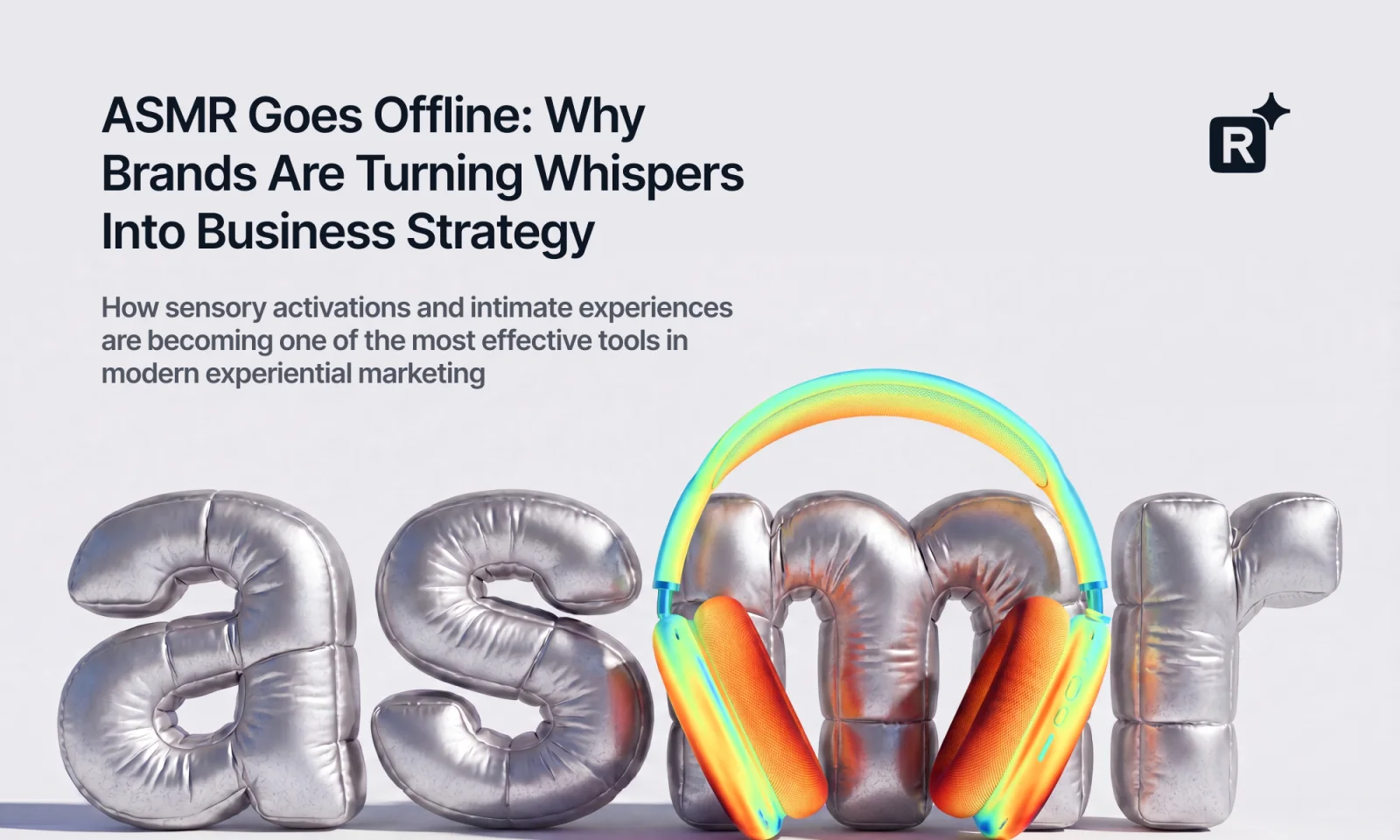
For years, ASMR existed almost entirely online.
It thrived in late-night YouTube rabbit holes, whispered TikTok clips and carefully crafted videos watched by millions looking to relax, fall asleep or simply take a break from the constant noise of digital life. What started as a niche internet subculture has grown into a global content phenomenon with audiences that rival those of mainstream entertainment formats.
Now it's moving beyond the screen.
Across retail, beauty, wellness and consumer brands, companies are beginning to experiment with ASMR as a real-world experience rather than a content category. In 2026, activations built around sound, touch and sensory engagement are gaining traction—not because they're bigger or more technologically advanced than traditional brand experiences, but because they offer something increasingly difficult to find: a moment of genuine focus.
At a time when consumers are surrounded by notifications, digital signage, interactive displays and endless streams of content, some of the most effective brand experiences are doing less, not more.
The End of Bigger-Is-Better Marketing
For much of the last decade, experiential marketing operated under a simple assumption: scale wins.
Brands invested in larger installations, more elaborate activations and increasingly ambitious social-media moments. Success was measured by visibility—how many people attended, how many photos were taken, how many posts appeared online.
But visibility and memorability are not the same thing.
Consumers have become highly efficient at filtering out spectacle. A giant installation may attract attention, yet leave little lasting impression once the experience is over. In crowded categories, attention is relatively easy to buy. Meaningful engagement is much harder.
This is where ASMR stands apart.
Unlike traditional experiential campaigns, sensory activations are designed to lower stimulation rather than increase it. They don't compete for attention through noise or novelty. They create conditions in which attention naturally settles.
The experience feels less like advertising and more like a personal interaction.
Why Sensory Experiences Are Resonating Now
The growing interest in ASMR reflects broader changes in consumer behavior.
After years of digital acceleration, people are placing greater value on experiences that feel tangible, human and emotionally restorative. Wellness is no longer confined to fitness studios or nutrition plans. It has become a lens through which consumers evaluate everything from hospitality and retail to entertainment and brand interactions.
ASMR sits comfortably within that shift.
Its defining characteristics—soft sounds, repetitive movements, tactile engagement and close personal attention—create a sense of presence that has become surprisingly rare. In a culture built around multitasking, ASMR encourages people to focus on a single sensory experience.
That matters because memory is closely tied to emotion. Consumers are far more likely to remember an experience that made them feel calm, comforted or cared for than one that simply demanded their attention.
As trust in advertising continues to erode, the emotional experience surrounding a brand can be just as influential as the message itself.
From Internet Trend to Marketing Strategy
Several campaigns launched this year suggest that brands are beginning to treat ASMR as something more substantial than a social-media trend.
Claire's "A Girl SMR at Claire's" campaign transformed parts of its retail environment into interactive sensory studios where Gen Alpha consumers could create their own ASMR content using products from the brand.
The significance of the campaign goes beyond user-generated content.
It reflects a broader evolution in youth marketing. Younger consumers increasingly expect to participate in brand experiences rather than passively consume them. Identity today is not simply expressed through brands—it is created alongside them.
PetAg approached the trend from a completely different direction. Instead of focusing on creators, the company built an experience around a familiar ritual for pet owners: the sounds of dogs eating. Crunching, chewing and licking became the foundation for a sensory campaign that turned an ordinary moment into something unexpectedly engaging.
The connection between these campaigns isn't ASMR itself.
It's their ability to elevate everyday experiences and make them feel more meaningful.
The Business Case Behind the Trend
At first glance, ASMR activations can appear niche. The commercial logic behind them, however, is increasingly difficult to ignore.
One of the longstanding challenges of experiential marketing is that consumers often enjoy the experience but fail to build a lasting connection with the brand behind it.
Sensory activations tend to work differently.
Because they encourage people to slow down and become more present, they often generate longer dwell times and deeper engagement. The format also lends itself naturally to content creation and sharing, extending the life of an activation far beyond the physical space itself.
Perhaps more importantly, these experiences create an impression that many brands struggle to achieve: they feel considerate.
Consumers increasingly expect companies to understand not only what they need but also how they feel. Experiences that reduce stress or create moments of comfort can strengthen emotional affinity in ways that traditional advertising rarely manages.
Viewed through that lens, ASMR is less about sound than it is about trust.
Not Every Brand Should Follow the Trend
That doesn't mean every company needs a whisper-based activation.
Like most experiential formats, ASMR can quickly feel contrived when there is no clear connection to the product or customer journey.
Luxury brands can build around craftsmanship and tactile detail. Beauty brands can draw on textures, rituals and personal care. Hospitality businesses can use sensory design to shape how guests experience a space.
For other categories, the fit may be less obvious.
Consumers are increasingly sensitive to anything that feels performative. When intimacy is manufactured rather than authentic, the effect can be awkward rather than engaging.
The strongest activations are usually the simplest ones—those where the sensory experience emerges naturally from the product itself.
What ASMR Says About the Future of Experiential Marketing
The rise of ASMR activations points to a broader shift taking place across the industry.
For years, experiential marketing was largely driven by reach and visibility. Today, marketers are paying closer attention to depth, emotional resonance and memory.
Brands are beginning to recognize that not every meaningful experience needs to be bigger, louder or more technologically complex than the one before it.
Sometimes what stands out is the opposite.
A moment of focus.
A moment of calm.
A moment that feels personal in a marketplace increasingly designed for scale.
The future of brand experience may not be immersive. It may be intimate.
As one experiential strategist recently observed, judging by the growing interest in sensory activations, consumers seem ready for exactly that.