



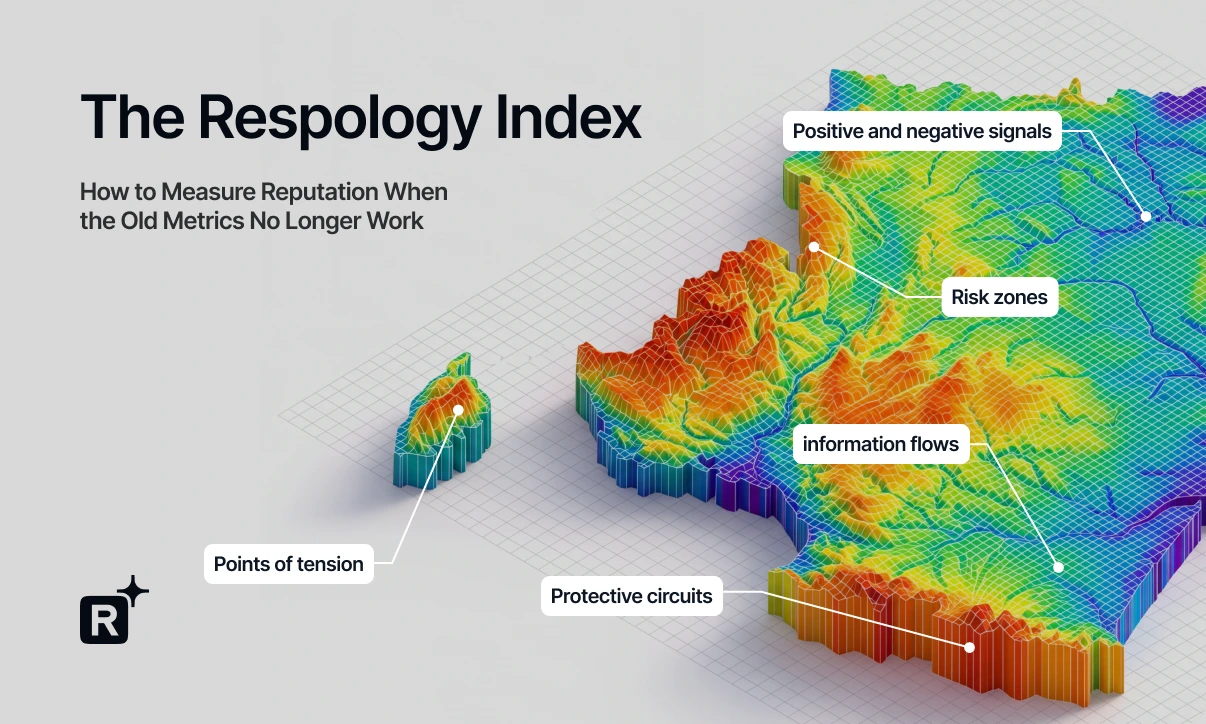
Corporate reputation has always been a company’s most valuable — and most fragile — financial asset. Yet until recently, we measured it the way people once measured the weather: glance at the sky, note “cloudy” or “clear,” and move on. Mentions, sentiment, share of voice, NPS, Brand Health Index — all of these produced a picture. Sometimes flattering. Often late. Almost never actionable.
While businesses kept counting “how much is being written about us” and “what percentage is negative,” the digital ecosystem evolved. AI search overviews now shape investor and stakeholder first impressions faster than any financial journalist. Negative narratives travel at unprecedented speed. A single unmanaged search result, a data leak, or a careless remark from a senior executive ranking on Google’s Page 1 can rewrite public perception and impact valuation in twenty-four hours more thoroughly than a year of careful PR work.
This is where reactive PR ends, and proactive Corporate Search Engine Reputation Management (SERM) begins. Enter the Respology Index — powered by our proprietary RESP Model™.
Not Another PR Score. A Risk Management System
Most existing online reputation management (ORM) indices answer a single, backward-looking question: “How are we perceived right now?”
The RESP Model™ answers four critical business questions:
R — Reputation Surface
This measures what is actually visible about your enterprise. Not what your corporate communications team believes is visible, but what the market, the customer, the investor, the AI system, and the journalist encounter during their due diligence. We audit your entire public surface: Google Page 1 search results, tier-1 media coverage, executive LinkedIn profiles, financial forums, and generative AI (LLM) answers.
E — Exposure Risk
This identifies exactly where your corporate narrative can break. A digital reputation can look flawless today and collapse tomorrow if unresolved vulnerabilities sit beneath it. RESP measures not only current negative search results but the probability of future crises: toxic legacy articles waiting to surface, over-reliance on single media sources, unprotected C-level digital footprints, and the velocity at which a negative narrative could spread.
S — Sentiment Dynamics
This goes beyond merely “positive / negative,” tracking exactly how perception is changing. At what speed, in which direction, driven by which themes, and across which search queries? Here the concept of Sentiment Velocity enters the picture — the rate of change in public attitude. By monitoring how AI engines synthesize your brand over time, this metric provides a trajectory, not just a snapshot.
P — Protection Strategy
This dictates what needs to be done to secure your enterprise value. Not generic advice to “strengthen PR,” but a concrete map for Information Dominance: which content gaps to close first, how to employ strategic content displacement to suppress vulnerabilities, and how to build a robust “digital moat” around your brand and executives.
These four components produce a single RESP Score — a number from 0 to 100. Yet the true power of the model does not lie in the number itself. It lies in the fact that behind the number, the board of directors immediately sees the exact state of their digital asset and the roadmap to protect it.
Why the RESP Model Matters in the AI & Search Era
Traditional ORM metrics worked reasonably well in a world where information moved slowly and corporate websites were the primary source of truth. Today, reputation lives in an environment of high velocity and low predictability. AI systems and search algorithms no longer merely index content — they synthesise your company’s image based on top-ranking search data. If your digital footprint contains gaps or unmanaged vulnerabilities, the algorithms will keep reproducing them.
Companies that continue to measure reputation solely through the volume of media mentions are essentially driving by looking in the rear-view mirror. They see what has already happened. The RESP Model™ allows you to see what may happen — and to build a digital fortress in advance.
The stress-testing component of RESP is particularly revealing. The model allows your Search Engine Reputation to be run through realistic shock scenarios: an acute media crisis, a leadership scandal, a coordinated competitor attack, or a regulatory investigation. For each scenario, we calculate the expected drop in your Score, the speed of algorithmic decline, and the necessary SEO/content responses. This is no longer a PR report. It is a vital reputation risk-management tool.
From Passive Measurement to Active SERM Management
The most important distinction between RESP and legacy PR approaches can be stated simply:
The old approach: Count the mentions → determine the sentiment → produce a report.
The RESP approach: Audit the search surface → identify algorithmic vulnerabilities → understand sentiment dynamics → deploy strategic content to protect and dominate.
That is why Respology deliberately speaks of a “model” rather than an “index.” An index merely shows a result. A model explains the algorithmic system and makes it possible to actively manage your corporate narrative.
The Future of Enterprise Reputation
The ambition of the Respology Index is serious: to become for corporate reputation what NPS became for customer experience — a clear, standardized, and regularly used language of business.
When, a few years from now, a CEO asks “What’s our RESP?” and understands by that not some vague notion of PR, but the concrete state of their Google Page 1, the level of digital exposure risk, and the strength of their digital moat — the model will have succeeded.
For now, it is the ultimate tool for corporate leaders who have grown tired of managing reputation in a permanent reaction mode. It is for those who want to see not only what has already happened, but what can still be prevented through strategic, white-hat Search Engine Reputation Management.
Stop guessing. Start measuring your digital risk.
Before launching a reputation campaign, you need to know your baseline. Contact Respology today to request a comprehensive RESP Model™ Audit for your enterprise, and discover exactly where your search engine vulnerabilities lie.